Is College Still Worth It in 2026? How Your Degree and School Affect Return on Investment
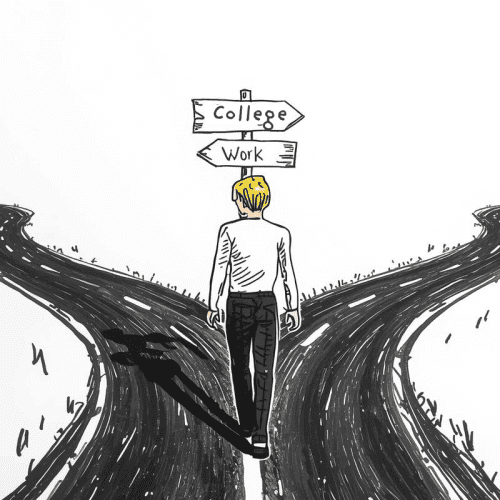
For decades, the case for college was straightforward: earn a degree, get a better job, and make more money.
Today, that equation feels a little less certain.
Artificial intelligence can already draft reports, analyze data, write code, and automate tasks that once helped new graduates gain experience in entry-level roles. So for many people considering college, that raises a fair question:
If AI is reshaping the workforce, is college still worth the investment?
The evidence suggests that, for many students, the answer is still yes. But the conversation about higher education is changing. Increasingly, the focus is not simply on whether a degree has value, but which degrees, institutions, and career pathways provide the strongest return on investment.
The earnings advantage of a college degree remains significant
At a broad level, the data is still clear: people with college degrees tend to earn more.
Workers with a bachelor’s degree earn about $1,533 per week on average, compared with $946 per week for workers with only a high school diploma, according to the U.S. Bureau of Labor Statistics. Over time, that earnings gap can translate into substantially higher lifetime income.
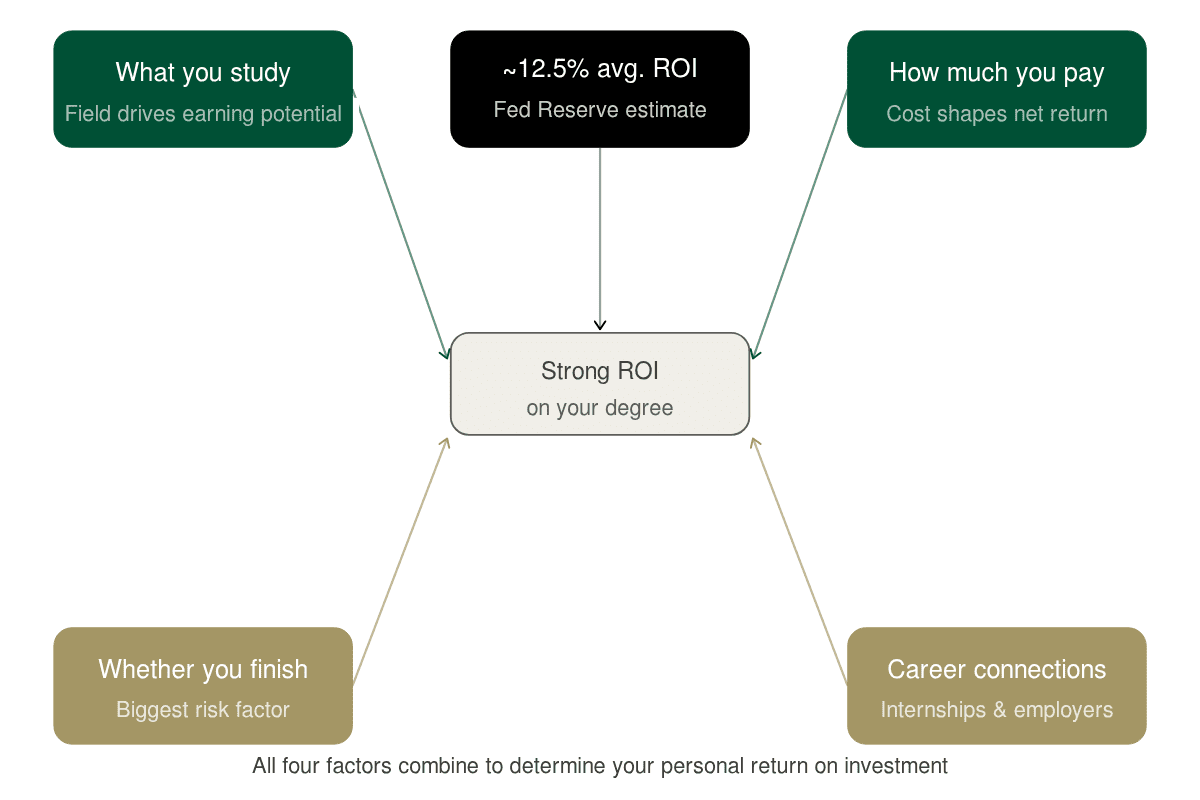
Economists at the Federal Reserve Bank of New York estimate that the average return on a college degree is around 12.5 percent, a level they consider a strong long-term investment.
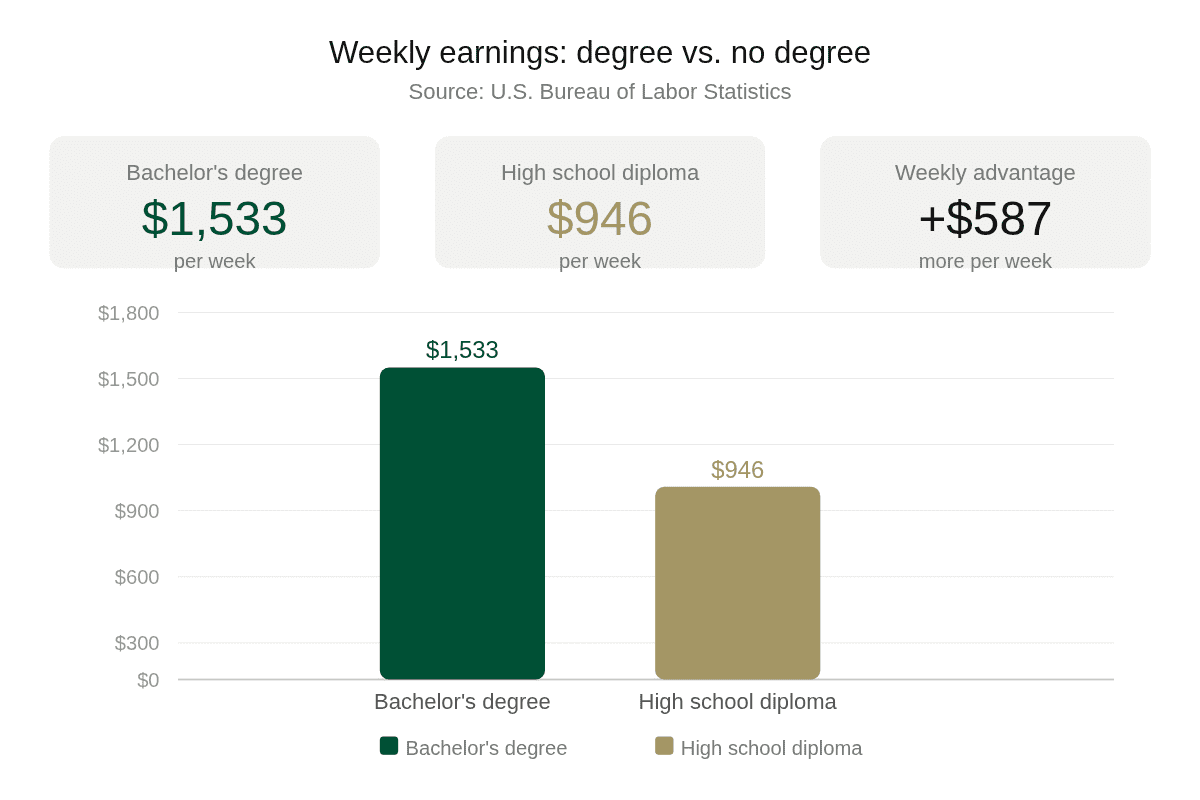
But those numbers are averages, and averages don’t tell the whole story.
Not every degree leads to the same outcome. Not every school costs the same. And not every student finishes.
So while college still can pay off, the better question today is:
Which college path is most likely to pay off for you?
North Carolina provides a strong example of how ROI works
If you want to see how those differences play out, North Carolina offers a useful example.
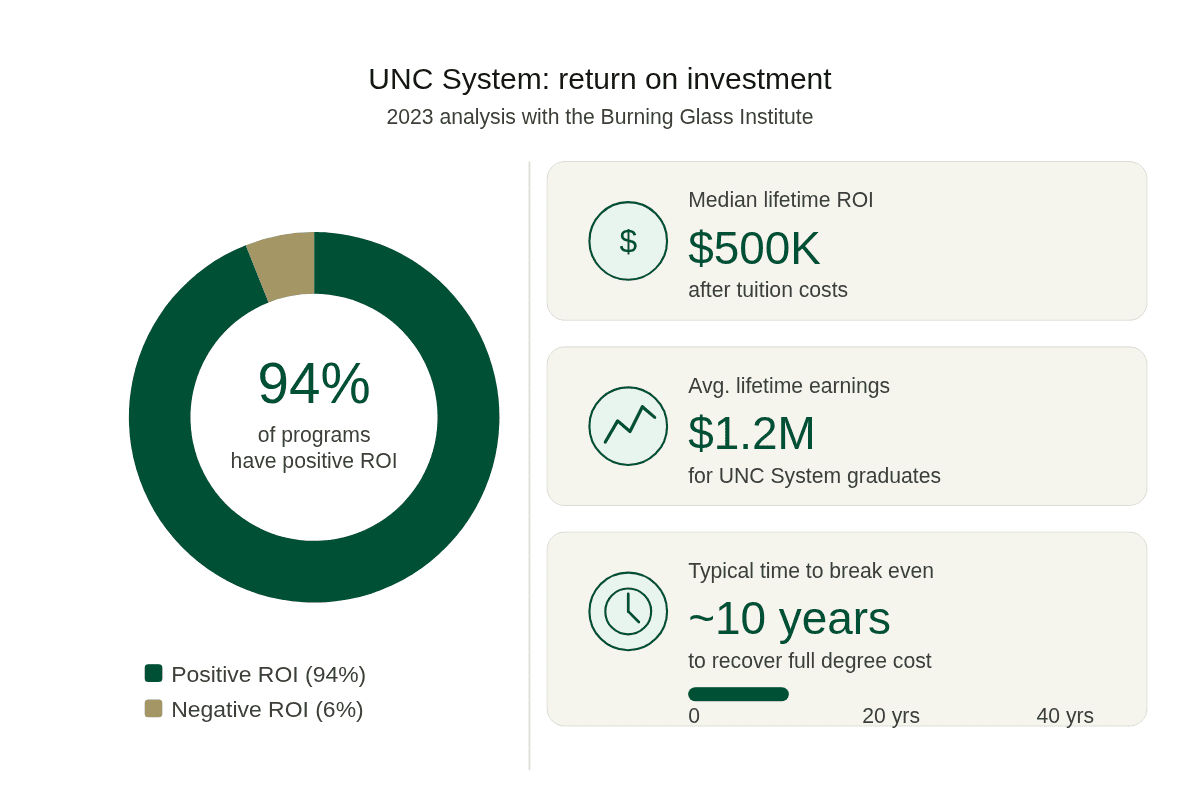
Across the University of North Carolina System, a 2023 return on investment analysis conducted with the Burning Glass Institute found that graduates see a median lifetime return on investment of about $500,000 after accounting for tuition costs.
At the same time:
- 94% of undergraduate programs produce positive financial returns
- Graduates earn about $1.2 million over their lifetimes on average
- Many students recover the cost of their degree within about 10 years
Those results come down to two things: keeping costs manageable and offering programs that lead to real career opportunities in fields like healthcare, business, education, engineering, and technology.
Across North Carolina, schools like UNC Charlotte have taken a similar approach by designing programs around what employers need, especially in areas like business, healthcare, and technology.
And students are still responding to that value. Enrollment across the UNC System increased by about 3.4% for the 2025–26 academic year, suggesting that many still see college as a pathway to long-term stability.
AI is changing how careers begin
At the same time, it’s important to be honest about what’s changing.
AI is starting to reshape the kinds of tasks that many entry-level professionals used to handle. Writing, research, coding, and data analysis are all evolving.
That doesn’t mean those careers are disappearing, but it does mean the starting point looks different.
Today, many roles expect graduates to:
- interpret information
- make decisions
- collaborate across teams
- use tools like AI effectively
In other words, it’s no longer just about what you know. It’s about how well you can apply that knowledge in a changing environment.
Why industry connections matter more than ever
That’s where one factor stands out: how closely a program is connected to the workforce.
Some programs focus primarily on coursework. Others go further by building in:
- internships
- applied projects
- employer partnerships
- mentorship opportunities
- real-world problem solving
Those experiences can make a big difference, especially when employers expect new hires to contribute quickly.
Programs designed for working adults, including many online options, often place a stronger emphasis on this kind of real-world application. They’re built not just for flexibility, but for helping students apply what they’re learning right away.
In the Charlotte region, that connection is especially strong. With growing industries in finance, healthcare, logistics, energy, and technology, students have more opportunities to engage with employers while completing their degrees.
That focus on career alignment is one reason Charlotte continues to stand out nationally. In the 2026 U.S. News & World Report rankings, UNC Charlotte’s online bachelor’s programs were ranked No. 1 in North Carolina and No. 4 in the nation, marking the fifth straight year in the top 10.
Rankings aren’t everything, but they can reflect something important: how well programs support students and prepare them for real careers.
One of the biggest risks isn’t choosing wrong. It’s not finishing.
There’s one more factor that doesn’t get talked about enough.
The biggest financial risk in college isn’t always picking the wrong major. It’s not finishing the degree at all.
Students who leave without graduating may still have student debt, but without the credential that increases earning potential.
That’s why practical factors matter just as much as academic ones. Things like:
- flexible scheduling
- support for working students
- clear program pathways
- access to advising
These can all play a major role in helping students stay on track and complete their degree.
If you’re comparing options, tools like the U.S. Department of Education’s College Scorecard can help you look at real outcomes, like graduation rates, earnings, and student debt.
So, is college still worth it?
In many cases, yes.
But the answer depends more than it used to.
The data still shows that college graduates tend to earn more and experience greater job stability over time. Research from both national sources and North Carolina institutions points to strong returns for many degree programs.
What’s changed is how much the outcome depends on the choices students make along the way.
Today, getting a strong return on investment is less about whether you go to college, and more about:
- what you study
- how much you pay
- whether you finish
- and how well your program connects to real career opportunities
In an economy shaped by AI, those connections matter more than ever.
Because the value of a degree isn’t just about earning it.
For many students, that means looking for programs that combine flexibility with strong ties to employers, especially those embedded in growing economic regions like Charlotte.
It’s about what it allows you to do next, and how prepared you are to take that next step.